
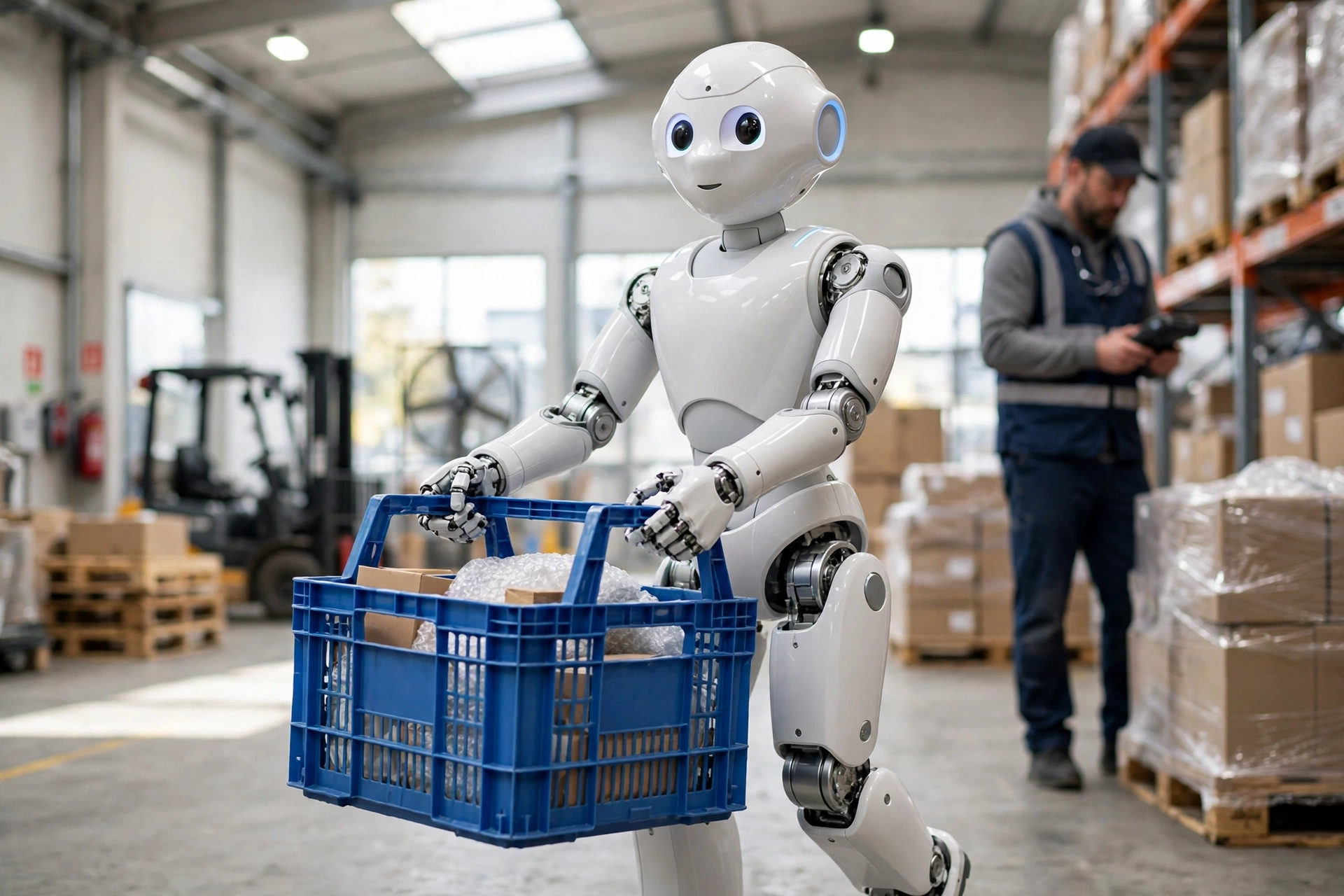
Walk through a warehouse in Georgia this week. Or a marathon route in China. Or a convenience store livestream. In each place, you might spot the same strange sight: a robot shaped roughly like a person, doing a job. Not a robot arm bolted to the floor. A machine with two legs, two arms, and a head, walking, reaching, and carrying things.
That shape is the whole point — and the whole problem. Humanoid robots explained simply means this: machines built like us so they can work in places built for us. Stairs, door handles, shelves, tote bins. If a robot looks like a person, it can, in theory, use the world we’ve already made. The catch is that looking like a person is the easy part. Working like one is not.
This week is a good moment to sort the real progress from the showmanship. Humanoid robots are suddenly everywhere in the news at once, and the stories say very different things.
Humanoid Robots Explained in Plain Words
Strip away the marketing and a humanoid robot is three things stuck together. There’s a body: legs, arms, hands, sensors for balance and touch. There’s a brain: software that decides what to do next, often an AI model that can plan a task step by step. And there’s a training history: hours of practice, much of it in simulation, before the robot ever touches a real shelf.
That last part matters more than most demos let on. A robot that stacks boxes in a video has usually practised that exact motion thousands of times. Change the box size, move the shelf six inches, or put a person in its path, and the same robot can hesitate, fumble, or stop entirely. So when you watch a clip, ask yourself a plain question. Is this robot doing one rehearsed job? Or can it cope when the day goes off-script?
Our earlier guide to AI agents in 2026 explains why this is getting better: modern AI can break a goal into steps, use tools, and adjust when something changes. A humanoid robot is, in a real sense, an AI agent with a body. The agent decides; the body executes. When either half is weak, the whole thing looks clumsy.
Why Humanoids, and Why Now?
Factories already have robots. They are fast, precise, and mostly shaped like arms. So why build a robot with legs?
The honest answer is flexibility. An arm robot is brilliant at one station and useless ten feet away. A humanoid can, in principle, walk to the next job, pick up a different object, and work beside people in a space designed for humans. Warehouses, shops, and hospitals are full of stairs, narrow aisles, and handles made for human hands. A machine shaped like us doesn’t need the building rebuilt around it.
Three things have pushed this from lab curiosity to live trials. First, AI models got much better at planning and seeing. A robot can now look at a cluttered tote and pick out the item it needs, most of the time. Second, sensors and motors got cheaper and smaller, so a walking robot is no longer a one-off research project. Third, companies started renting robots instead of selling them. Under a robots-as-a-service deal, a warehouse pays for the work done, not the machine itself, which makes trying one far less risky.
None of that means the technology is finished. It means the trials are finally cheap enough, and useful enough, to run in real buildings.
Where They’re Actually Working This Week
Forget the sci-fi trailers for a minute. Here’s what humanoid robots have genuinely been doing in the last few days.
In a Georgia warehouse, moving totes
The clearest working example is Digit, built by Agility Robotics. Since 2024, Digit has worked in live operations at a GXO Logistics warehouse in Flowery Branch, Georgia, moving totes — the stackable bins that carry goods around a warehouse. On 26 October 2026, GXO and Agility announced the partnership will expand to two more sites, in Statesville, North Carolina and Lebanon, Tennessee, starting in early 2027.
GXO says Digit has moved more than 100,000 totes at the Georgia site. That’s a real number from a real building, not a lab demo. It’s repetitive, measurable work, done day after day. That’s why this deployment keeps getting cited. The new sites will start with the current Digit 4 model and move to Digit 5 when it’s commercially available. Agility says Digit 5 runs for 90 minutes on a 9-minute charge. That’s a big jump from its predecessor. It also shows how much battery life still shapes what these robots can do.
Notice what the job is, though. Digit moves totes. It doesn’t run the warehouse. The first commercial humanoid jobs are narrow, repetitive tasks where a robot’s patience is an advantage and its slowness doesn’t matter much.
On a marathon route, helping police
On 1 November 2026, a humanoid robot called Hangxing No.2 worked alongside traffic police at the Hangzhou Marathon in China. Built by DEEP Robotics, the 178cm robot patrolled four points around the Huanglong Sports Center. Using LiDAR and cameras, it followed set paths, issued traffic safety alerts, and answered questions from the public.
That’s a genuinely public job — crowds, noise, unpredictable people. But read the details and the limits show up too. The robot followed pre-determined paths and monitored spots fixed cameras couldn’t reach. It assisted officers; it didn’t replace them. A marathon is a useful test because it’s busy and messy, but the robot still had a planned route and a defined task.
In a shop and a factory, on camera
Chinese robotics firm AGIBOT ran a 24-hour livestream from 2 to 3 November 2026. It showed six of its G2 humanoid robots working in a convenience store. Their jobs: stocking shelves, making coffee and hot food, greeting customers, and clearing rubbish. Around the same time, Xiaomi released video of two of its full-size humanoid robots sorting car parts during an eight-hour shift at its car factory.
Both are worth watching — and worth reading with care. A 24-hour livestream doesn’t mean each robot worked 24 hours without charging, maintenance, or human help. Xiaomi hasn’t published sorting speeds, error rates, or how battery swaps were handled during its eight-hour test. A demo proves a robot can do a task. It doesn’t prove it can do that task all shift, every shift, without a person standing by.
That’s not a criticism of the robots. It’s the difference between a rehearsal and a job. Every new technology looks magical in a video. The warehouse in Georgia is interesting precisely because it isn’t a video — it’s a contract, renewed and expanded.
What They Still Can’t Do
So what stops you from buying one for your home? Quite a lot, still.
Hands are the first problem. Human hands are absurdly good: soft enough to hold an egg, strong enough to open a jar, quick enough to catch something slipping. Robot hands can grip a tote or a car part. They can’t yet fold laundry, button a shirt, or cook a meal without a lot of help. Most humanoid demos quietly stick to objects that are easy to grab.
Batteries are the second problem. A robot that works for 90 minutes and charges for 9 is a big improvement. Even so, it still needs regular breaks built into its working day. And it needs a charging plan to go with them. Your phone has the same problem, but your phone doesn’t need to walk back to its charger by itself.
Safety is the third, and it’s the one companies talk about least in their launch videos. A 60-kilo machine walking near people must never fall on someone, crush a hand, or misread a child running past. That means slow speeds, careful sensors, and lots of testing in controlled spaces before any public deployment. The Hangzhou robot worked with police officers nearby for a reason.
Then there’s cost. Neither GXO nor Agility has disclosed the financial terms of the expansion. And a robot that needs engineers on call is not yet a cheap worker. The business case today rests on repetitive jobs in big facilities, not on replacing people in small shops or homes.
Our guide to digital twins explains one way companies are closing this gap. Robots practise in a virtual copy of the real workplace before they ever enter it. That way, mistakes happen in simulation instead of on the shop floor. That training helps a lot. It doesn’t remove the gap between a practised task and a messy real day.
What About Jobs?
This is the question most readers actually care about, and the honest answer is slower and less dramatic than the headlines.
Right now, humanoid robots are taking the most repetitive, physically tiring jobs first: moving bins, sorting parts, stocking shelves. Those are real jobs, and the people doing them deserve a straight answer about what’s changing. But the deployments so far are small: a handful of robots per site, doing one task. They also come with new work attached. Someone has to supervise the robots, fix them, plan their routes, and handle everything they can’t do yet.
Think of the warehouse pattern. The robot moves totes so people can do the picking, packing, and problem-solving that needs judgment. That’s the shape of the next few years: robots handling the dull, heavy, repetitive slice, while people handle the exceptions. A robot that stops when a box is torn or a label is missing still needs a person nearby who knows what to do next.
Will that change? Yes, gradually. But anyone telling you humanoid robots will replace household staff or office workers next year is selling something. The robots that exist today are warehouse and factory workers in training, not general-purpose helpers.
How to Read the Next Humanoid Headline
You’ll see plenty more of these stories in the coming months. Tesla, for one, says production of its Optimus robot has begun in Fremont, California. It’s in an early ramp phase. Here’s a quick checklist that will save you from most of the hype.
First, ask what the robot actually did, in one sentence. “Moved totes for a year under contract” means far more than “dazzled crowds at a launch event.” Second, ask how long it did it without help. A task done once on camera is a demo; a task done for months is a deployment. Third, look for numbers the company didn’t choose itself — independent tests, error rates, and costs. Vendor numbers are a starting point, not a verdict. Fourth, notice what’s missing from the video. Hands doing fiddly work, stairs, crowds, and wet floors are where robots still struggle, so demos tend to avoid them.
If a story passes those four checks, it’s worth your excitement. Most won’t, and that’s fine. The field is moving fast enough without exaggeration.
Frequently Asked Questions
Can I buy a humanoid robot for my home yet?
Not in any practical sense. The robots in the news are commercial machines deployed in warehouses, factories, and supervised public trials. There’s no general-purpose home humanoid you can buy, set up, and trust with daily chores.
Are humanoid robots better than regular industrial robots?
Not at most factory jobs. A fixed robot arm is faster, cheaper, and more precise at one repeated task. Humanoids win on flexibility — they can move between jobs in a space built for people — but they pay for that with slower speed, higher cost, and more complexity.
Why do they need AI at all? Can’t they just follow a program?
A fixed program works when everything stays the same. Real workplaces don’t. AI helps a robot recognise objects it hasn’t seen before, plan steps when something changes, and recover when a grip fails. That’s also why our neuromorphic computing guide matters here: brain-like chips that react quickly to sensor changes could one day help robots respond faster while using less power.
Will humanoid robots take everyone’s job?
No — not on any timeline you should plan around. Today’s deployments are narrow, supervised, and small in number. The realistic near-term change is that some repetitive manual tasks get shared between people and robots, with new roles supervising and maintaining the machines.
The Bottom Line
Humanoid robots explained honestly, then, looks like this. The shape makes sense. The AI is finally good enough for narrow jobs. And real deployments — above all Digit’s warehouse work — prove the idea isn’t just a demo anymore. But hands are still clumsy, batteries still short, safety still demands supervision, and most of what you’ve seen on video is a rehearsal, not a shift.
Watch the warehouses, not the trailers. When a robot does the same dull job for months, expands to a second site, and keeps its numbers up without a film crew present, that’s progress you can believe. By that measure, November 2026 is a genuine milestone — just a smaller, more useful one than the headlines suggest. The robot revolution isn’t arriving in your living room tomorrow. It’s clocking in at a warehouse in Georgia, one tote at a time, and that’s exactly where it should start.
Sources: GXO Logistics and Agility Robotics — expansion of Digit humanoid deployment, 26 October 2026.