
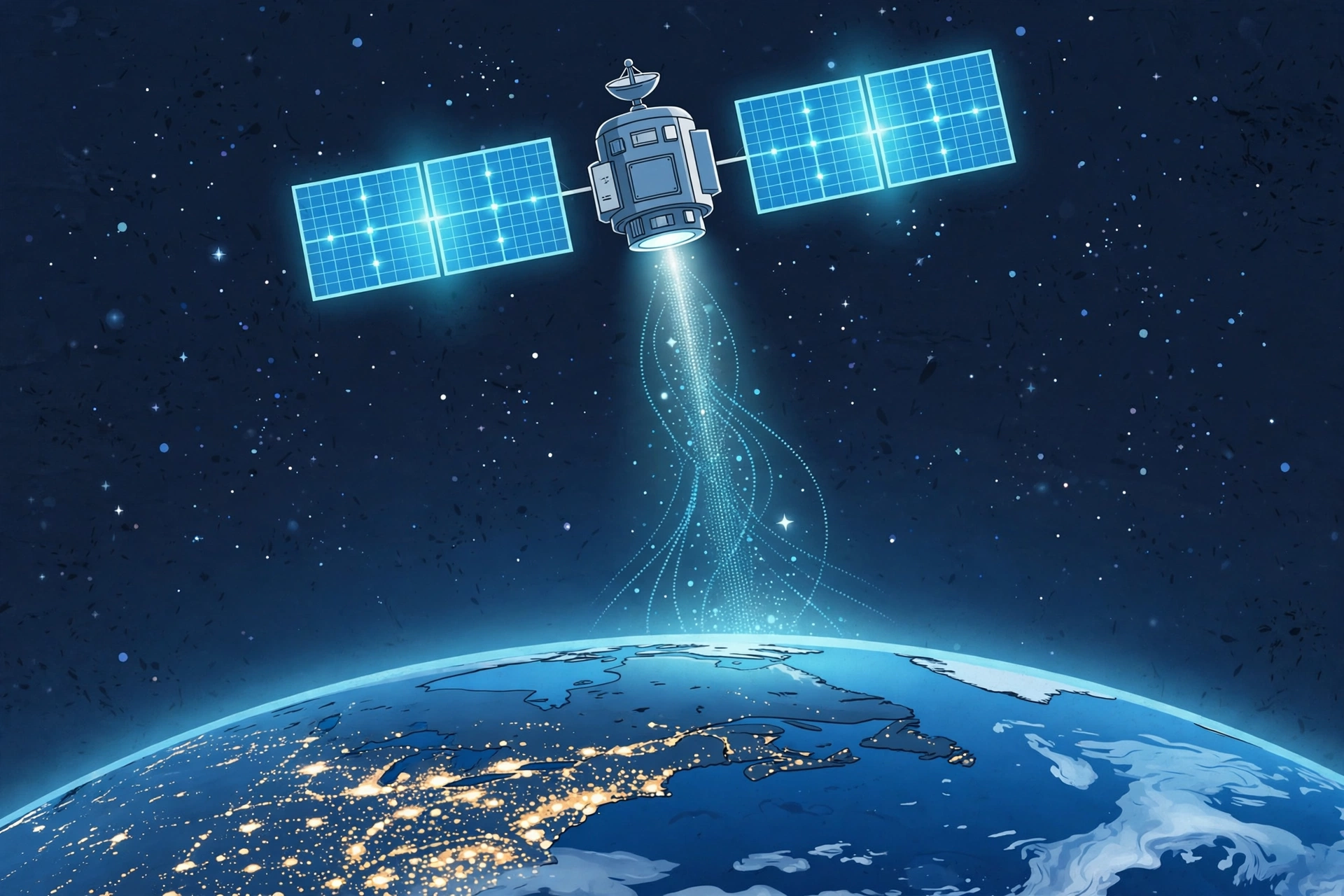
An AI chip floating hundreds of kilometres above Earth was asked to write a poem. It answered.
That sounds like the opening of a science-fiction story, but it happened for real this week. Google’s Project Suncatcher satellite, carrying a data-centre-class AI chip, sent back its first AI-generated response from orbit: a short haiku about being in space. No one on Earth will notice a difference on their phone today. Still, the moment matters, because it proves something researchers have only talked about until now — that the kind of chip that powers AI in a data centre can actually run a workload up in orbit.
So what is Google Project Suncatcher, what did it really do, and what does it mean for the rest of us? Let’s sort the real news from the hype.
What Google Project Suncatcher actually did
Project Suncatcher is a Google Research project — the company calls it a moonshot, which is its word for a long-shot experiment — exploring whether AI computing could one day run in space. The first step was a prototype satellite, launched on 1 October 2026.
After launch, the team worked through a commissioning checklist. That meant powering up the satellite’s host and its chip trays, and running early machine-learning tests to make sure everything survived the trip and switched on properly. Only then came the test that made headlines.
During a pass over a ground station, Google’s team sent a prompt up to the satellite. The onboard chip ran Google’s Gemma 4 open model, which wrote a haiku about being in space. As the satellite passed by Svalbard, Norway, the answer came back down to Earth:
Blue marble below
Data streams in silent grace
Starlight feeds my core.
Google calls this its “Hello World” milestone: the first-ever AI response from a data-centre-class TPU in orbit. A TPU, or Tensor Processing Unit, is Google’s own kind of AI chip, built for the maths behind machine learning. Getting one to answer a prompt in orbit is the whole point of the test.
After the haiku, the team tried more prompts, including space-themed limericks and prompts that reported the technical status of the payload systems. In other words, the satellite did not just recite a poem and stop. It showed the full loop working: prompt goes up, chip runs the model, answer comes back down.
Why a poem? The point of a Hello World test
If you have ever learned to code, you will recognise the phrase. A “Hello World” program is the smallest possible test that proves the setup works. It is not meant to impress anyone. It is meant to answer one question: does this thing run at all?
That is exactly what happened here. A haiku is short, easy to check, and impossible to mistake for a glitch. If the downlinked text had come back garbled, the team would have known something was wrong. Instead, it came back clean, which told them the chain — uplink, chip, model, downlink — works end to end.
Think of it like the first phone call on a new network. The words do not matter much. The fact that the call connected is everything.
Why Gemma 4, and not Gemini?
One detail worth getting right: the model on board was Gemma 4, Google’s open model, not Gemini. Some quick summaries online got this wrong. Gemma is the smaller, openly available family of models that developers can download and run themselves, while Gemini is Google’s flagship product. For a prototype test, an open model that the team can load onto the satellite in advance makes sense. This was a hardware test first and a model test second.
Why put AI chips in space at all?
Here is the honest answer: because data centres on Earth are hitting real limits, and space offers something Earth cannot — endless sunlight.
A modern AI data centre eats enormous amounts of power and needs serious cooling. In space, sunlight is constant once you are above the atmosphere, with no clouds and no night in the same way we experience it on the ground. Google’s long-term idea is to explore whether AI compute could one day be powered by solar energy collected in space, rather than by grids on Earth.
There is a second, more practical reason researchers care. Satellites already collect huge amounts of data — images of Earth, weather readings, signals of all kinds. Today, much of that raw data has to be beamed down before anyone can make sense of it, which takes time and bandwidth. If a satellite could run an AI model on board and send down only the useful answer, that changes the maths completely. Imagine a satellite that spots a wildfire or a flood and sends an alert, instead of sending thousands of raw images for someone on Earth to sort through later.
None of that is happening yet. Google Project Suncatcher is a prototype, not a service. But it is easy to see why the idea appeals to a company that runs some of the world’s largest data centres.
It also connects to a trend you may already have noticed closer to home. Satellite internet has already changed what “online” means for people far from fibre cables, and AI agents are pushing more computing out of the chat window and into real tasks. Suncatcher sits where those two trends meet: AI, running not in a building, but in orbit.
What Project Suncatcher is not — yet
This is where most of the online excitement overshoots. Let’s be clear about what did not happen.
First, Google has not built a data centre in space. One prototype satellite with test hardware is not a data centre, any more than a single solar panel is a power station. The company itself describes this as the first step in a long-term research project.
Second, you cannot use it. There is no Suncatcher app, no sign-up, and no way for your phone or laptop to send work to a satellite. The only prompts so far have come from Google’s own team, for testing.
Third, it does not replace data centres on Earth. Space is a harsh place for electronics. Chips up there face radiation, wild temperature swings, and the shaking of launch itself. Coverage of the announcement notes the prototype carries four TPUs but can only run one at a time for short stretches, because of power and heat limits. That is normal for a first prototype, and it shows how far there is to go.
Finally, one successful haiku does not prove the hardware will keep working for months or years. That is precisely what the next round of tests is for.
What happens next: the tests that actually matter
Google says the next step is a series of tests on how its TPUs perform under thermal stress and radiation exposure in orbit. In plain terms: can the chips handle the heat, the cold, and the radiation of space, day after day, without errors creeping in?
That question matters more than the poem did. A chip that works once in a demo but fails after a month of radiation exposure is no use for anything serious. Verifying that the chips can reliably run workloads in space, Google says, paves the way for its next milestone: twin interconnected satellites in 2027.
Two satellites talking to each other would be a bigger test than one satellite talking to the ground. It would start to answer whether AI workloads could be split across spacecraft, the way they are split across racks in a data centre today.
It is also worth comparing this with a very different kind of chip experiment. Neuromorphic computing tries to make chips work more like a brain, using far less power for certain jobs. Suncatcher is asking a different question: not how to make the chip cleverer, but where the chip can live at all. Both ideas are really about the same problem — AI needs a lot of power, and researchers are hunting for smarter places and smarter ways to run it.
So what should you watch for? Not another poem. Watch for three things: results from the thermal and radiation tests, news of the twin satellites in 2027, and any sign that an onboard model did something useful with real satellite data, rather than just answering a test prompt. Those will tell you whether Suncatcher is growing into something real, or staying a clever experiment.
Does this change anything for you right now?
Not directly, and anyone telling you otherwise is selling something. Your phone will not get faster because a chip in orbit wrote a haiku. Your internet bill will not change. No product you can buy today uses Suncatcher.
But there is a reason to pay attention anyway. The biggest tech shifts rarely arrive as finished products. They arrive as small, slightly odd proofs that something works — a first call, a first flight, a first answer from orbit. Ten years from now, if AI really does run partly in space, people will point back to this week as the moment the hardware first proved it could.
Or it might go nowhere. Plenty of moonshots do. The honest way to follow Suncatcher is with curiosity, not with certainty. Google has shown the chip can answer. Now it has to show the chip can survive.
Frequently asked questions
What is Google Project Suncatcher?
Project Suncatcher is a Google Research experiment exploring whether AI computing could run in space, powered by solar energy. Its prototype satellite, launched on 1 October 2026, carries data-centre-class TPUs, and on 30 October 2026 Google announced its first AI response from orbit.
What did the satellite actually do?
During a ground-station pass, Google sent a prompt to the onboard Gemma 4 model, asking for a haiku about being in space. The satellite’s TPU ran the model and downlinked the poem as it passed Svalbard, Norway. Google then tested limericks and telemetry prompts too.
Can I use Project Suncatcher?
No. It is a research prototype, not a product or service. There is no public access, and no app or sign-up. The only prompts so far have been Google’s own tests.
Will AI data centres move to space?
Not any time soon. One prototype proving a chip can run in orbit is a long way from a working space data centre. Google’s next steps are thermal and radiation tests, then twin interconnected satellites in 2027. Real space data centres, if they ever happen, are years away.
The bottom line
A chip in orbit wrote a three-line poem, and that is genuinely worth a moment of wonder. Strip away the headlines, though, and the real story is simpler and more interesting: the hardware worked. A data-centre-class AI chip survived launch, switched on, ran a model, and sent a sensible answer home.
That is a first step, not a finish line. The tests that decide Google Project Suncatcher’s future — heat, radiation, reliability over time — have not reported yet. Until they do, the fair verdict is this: Google Project Suncatcher has proved AI can answer from space. Now it has to prove AI can live there. For more on the story, see Google’s own announcement of the first response from its Project Suncatcher prototype satellite.