
Your phone is warm in your pocket, and you haven’t even touched it for an hour. That’s not a fault. It’s the price of a chip that never really rests. It runs on a clock, checks everything in turn, and shuttles data back and forth between memory and processor millions of times a second. All that travelling burns energy, and you feel it as heat and a battery that drains too fast.
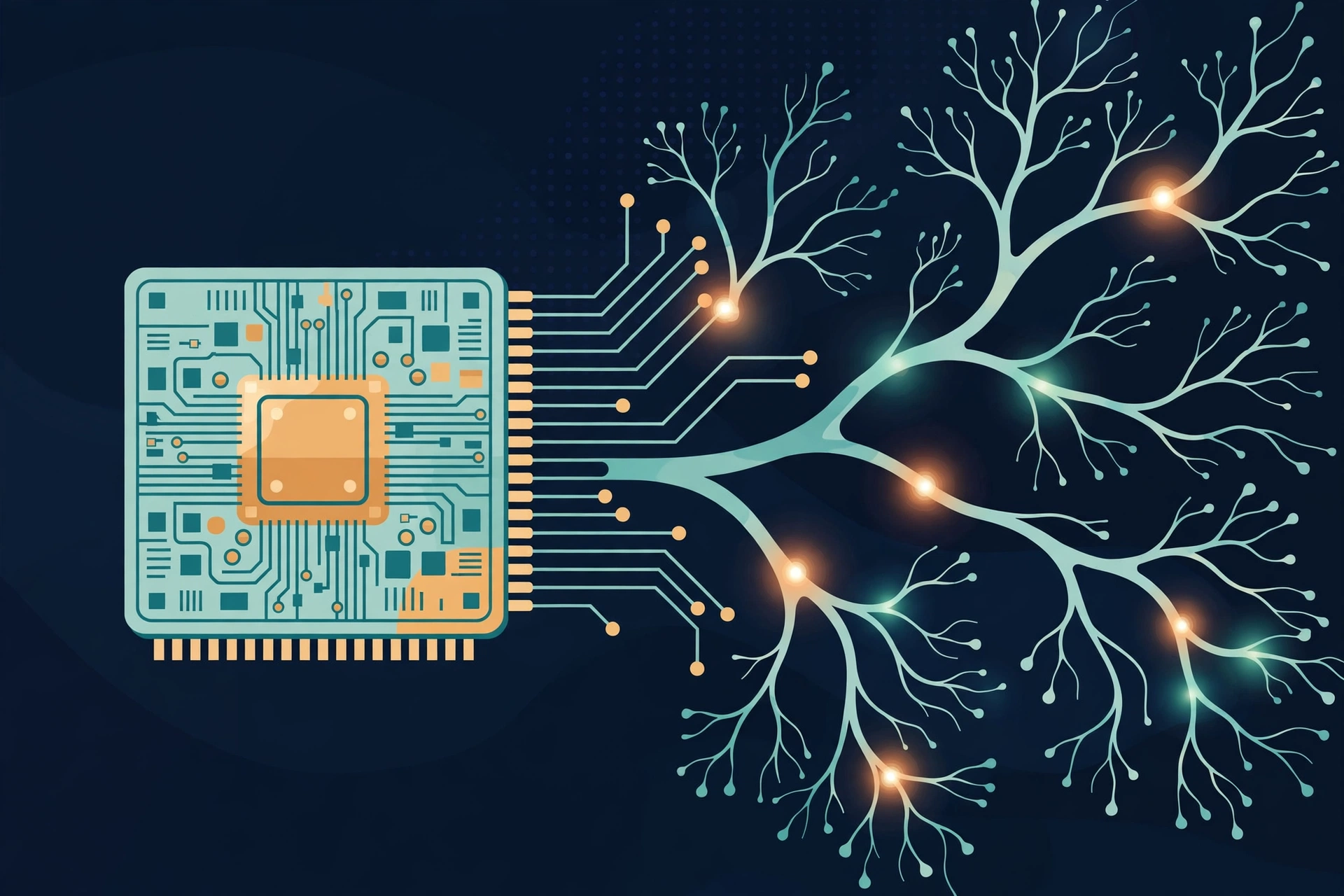
Now picture a chip that works the other way round. It sits quiet until something actually happens. Then it fires a quick signal, just where it’s needed, and goes quiet again. No constant clock. No endless fetching. That’s the idea at the heart of neuromorphic computing explained in plain words — chips that borrow tricks from the brain to do less work, not more.
It sounds like science fiction. It isn’t, quite. Research machines built this way already exist, and in October 2026 a chipmaker called BrainChip announced a new version of its Akida chip aimed at everyday gadgets like wearables and smart home devices. So this is a good moment to ask what the fuss is about, what it can actually do today, and what it can’t — yet.
Neuromorphic Computing Explained in Plain Words
Start with the problem. A normal computer keeps its memory and its processor in separate places. To do anything, it has to fetch data from memory, work on it, and send the result back. Do that billions of times and you get speed — but you also get a lot of wasted movement. Engineers call this the memory bottleneck, and it’s one reason powerful AI models need so much electricity.
A brain doesn’t work like that. In your head, memory and processing live in the same network of neurons and synapses. A neuron fires only when it receives enough input, and it sends a short pulse — a spike — to its neighbours. Nothing ticks away in the background. Nothing fetches data it doesn’t need.
Neuromorphic chips copy that pattern. They pack processing and memory close together on the same chip. They communicate with spikes instead of a steady stream of numbers. And they react to events: a sound, a movement, a change in a sensor reading. When nothing changes, they mostly idle. That is why people keep using the word efficient when they talk about them.
Think of it like the difference between a security guard who patrols every corridor every five minutes, and one who sits still until a door sensor trips. Both can catch an intruder. Only one of them is exhausted by lunchtime. That’s neuromorphic computing explained in a single picture: rest when idle, react when something happens.
Where You Can Already See It Working
This is still early technology, but it’s not just a lab curiosity. Here is neuromorphic computing explained through the places it already shows up, in terms you can picture.
Always-on gadgets that sip power
Imagine a pair of wireless earbuds that listen for a wake word all day without killing the battery. A normal chip would have to keep checking the microphone on a loop. A neuromorphic chip can wait for a sound event, wake up, and check whether it heard the right word. The same trick applies to a smartwatch that watches for a fall, or a home sensor that notices a window opening.
That’s exactly the market BrainChip aimed at with its AKD1500 SPI chip, announced on 22 October 2026. It pairs with the small microcontrollers already inside wearables and smart home products, and it can learn new sounds or patterns right on the chip — no trip to the cloud, no retraining on a server. For a gadget maker, that means adding a bit of on-device intelligence without redesigning the whole product.
Robots and sensors that must react fast
A robot hand that grips a fragile object needs to feel and adjust in milliseconds. Waiting for a round trip to a distant server is not an option, and neither is burning through a battery in an hour. Event-driven chips react to changes in sensor data as they happen, which suits machines that live in the real world rather than in a data centre.
The same logic explains the research interest in bigger systems. Intel’s Loihi 2 research chip, for example, has been used to build experimental machines with over a billion artificial neurons. Those machines are research tools, not products you can buy. Still, they let scientists test what brain-like hardware can do at scale — and where it breaks.
Spotting rare events in a flood of data
Some jobs involve watching a huge stream of data for something unusual: a strange vibration in a machine, an odd pattern in a heart monitor, a flicker in a camera feed. A neuromorphic system can sit on that stream cheaply, because it only spends energy when something changes. One recent example from October 2026 involved a brain-like chip analysing fusion plasma data at a million samples a second to flag instabilities before they damaged equipment. That’s a lab result, not a consumer feature. But it shows the same strength: cheap, fast attention to rare events.
If you want the bigger picture, our earlier guide to AI agents in 2026 explains why so much modern AI is hungry for power in the first place — and why a more efficient chip matters to everyone, not just engineers.
What It Means for an Everyday Reader
You probably won’t buy a “neuromorphic phone” any time soon. The change will arrive quietly, inside things you already own. Here’s what to realistically expect over the next few years.
First, longer battery life on small devices. Earbuds, watches, hearing aids and home sensors could run their smart features for much longer, because the chip doing the listening isn’t working flat out.
Second, smarter gadgets that don’t need the cloud for everything. A doorbell that recognises a familiar face, or a hearing aid that adapts to a noisy room, could do that work on the device itself. That also means less of your data travelling to a server — a genuine privacy upside, though it won’t remove the need for good security habits.
Third, cheaper intelligence in places where power is scarce. A farm sensor, a remote weather station or a medical monitor in a rural clinic can’t plug into a data centre. A chip that sips power makes on-the-spot intelligence possible there too.
None of this means your laptop is about to change. Ordinary chips are superb at the things they already do — spreadsheets, video editing, gaming, running a web browser. Brain-like chips are specialists, not replacements. For the foreseeable future, they’ll sit alongside normal processors, handling the sensing and reacting while the regular chip does the heavy lifting. That’s a useful way to think about it: a division of labour, not a takeover.
On that note, digital twins show a similar pattern — a virtual copy of a real thing, used to predict problems before they happen. Neuromorphic hardware and digital twins both try to make machines cheaper to run and quicker to react. They just attack the problem from opposite ends.
The Honest Limits (and Why They Matter)
Here’s the part most hype skips. The hardware has raced ahead of the software. Writing programs for spiking, event-driven chips is still hard. Most AI tools today assume the normal way of computing, so developers have to learn new methods or convert existing models — and conversion often loses accuracy.
That matters because a chip is only as useful as the software that runs on it. Until the tools get easier, neuromorphic chips will stay in niches where the power saving is worth the extra effort: sensing, robotics and always-on devices, rather than general computing.
There’s also a measurement problem. Companies describe efficiency in different ways, so comparing a neuromorphic chip with a normal processor isn’t straightforward. Independent, like-for-like tests on real workloads are still rare. So treat bold claims — especially about beating a data-centre GPU — with healthy scepticism until the numbers come from a source you trust.
And one more reality check: these chips don’t make AI itself smarter. They make certain kinds of AI cheaper and faster to run. The intelligence still comes from the model and the data. A brain-like chip running a bad model just gives you bad answers more efficiently.
If the satellite side of future tech interests you, our guide to satellite internet covers another technology that promises a lot, works well in specific places, and still has honest limits worth knowing before you get excited.
How to Follow This Without the Hype
So how do you keep up with a field like this without drowning in press releases? A few habits help.
Watch for products, not promises. A chip in a shipping gadget tells you far more than a research paper or a keynote slide. BrainChip’s October 2026 announcement counts as a small step here, because it targets real microcontrollers in real products — but the proof will be gadgets you can actually buy.
Ask what the chip replaces. If a neuromorphic chip does a job that a normal chip already does cheaply, the benefit is small. If it enables something that was impossible before — all-day listening on a tiny battery, for instance — that’s where the story gets interesting.
Finally, ignore any claim that comes with no number and no comparison. “Ultra-low power” means nothing on its own. Low compared with what, doing what job, measured how? If the answer isn’t in the announcement, file it under “interesting, unproven” and move on.
Frequently Asked Questions
Is neuromorphic computing the same as AI?
No — and this is neuromorphic computing explained at its simplest. AI is the software: the models that recognise speech, spot patterns or make decisions. Neuromorphic computing is a way of building hardware, inspired by the brain, that can run some of that software more efficiently. You can have AI without neuromorphic chips, and neuromorphic chips without much AI. They overlap, but they’re not the same thing.
Will neuromorphic chips replace the processor in my phone or laptop?
Not in the foreseeable future. Your phone’s processor is a general-purpose workhorse, and it’s very good at that job. Brain-like chips are specialists for sensing and event-driven tasks. Expect them to appear as extra chips inside devices, handling specific jobs, while the main processor carries on as before.
Why does the brain comparison keep coming up?
Because the design genuinely borrows from biology: neurons that fire in spikes, memory and processing in the same place, and activity only when something happens. But the comparison has limits. Today’s neuromorphic chips are crude sketches of a brain, not replicas — more like a stick drawing than a portrait.
When will I actually notice this technology?
Probably without noticing at all. The first signs will be small: earbuds that listen longer, a watch that reacts faster, a sensor that runs for years on one battery. If a product ever advertises a “brain-like chip” loudly, check what it actually does better — battery life and on-device smarts are the honest answers to look for.
The Bottom Line
Neuromorphic computing explained in full, then, is a simple idea with a hard execution: build chips that stay quiet until something happens, keep memory close to processing, and talk in spikes instead of a constant stream. That design already helps in always-on gadgets, fast-reacting robots and rare-event spotting — and the October 2026 Akida announcement shows chipmakers pushing it into everyday devices.
But the software still needs to catch up, the comparisons still need standardising, and ordinary chips aren’t going anywhere. So the smart way to think about this technology is not as a revolution arriving tomorrow. It’s a specialist tool, slowly finding the jobs where doing less work is exactly the point. And in a world where every gadget seems to need more power, a chip that knows when to stay quiet is an idea worth watching.
Sources: Intel — Neuromorphic Computing research; BrainChip — AKD1500 SPI announcement, 22 October 2026.