
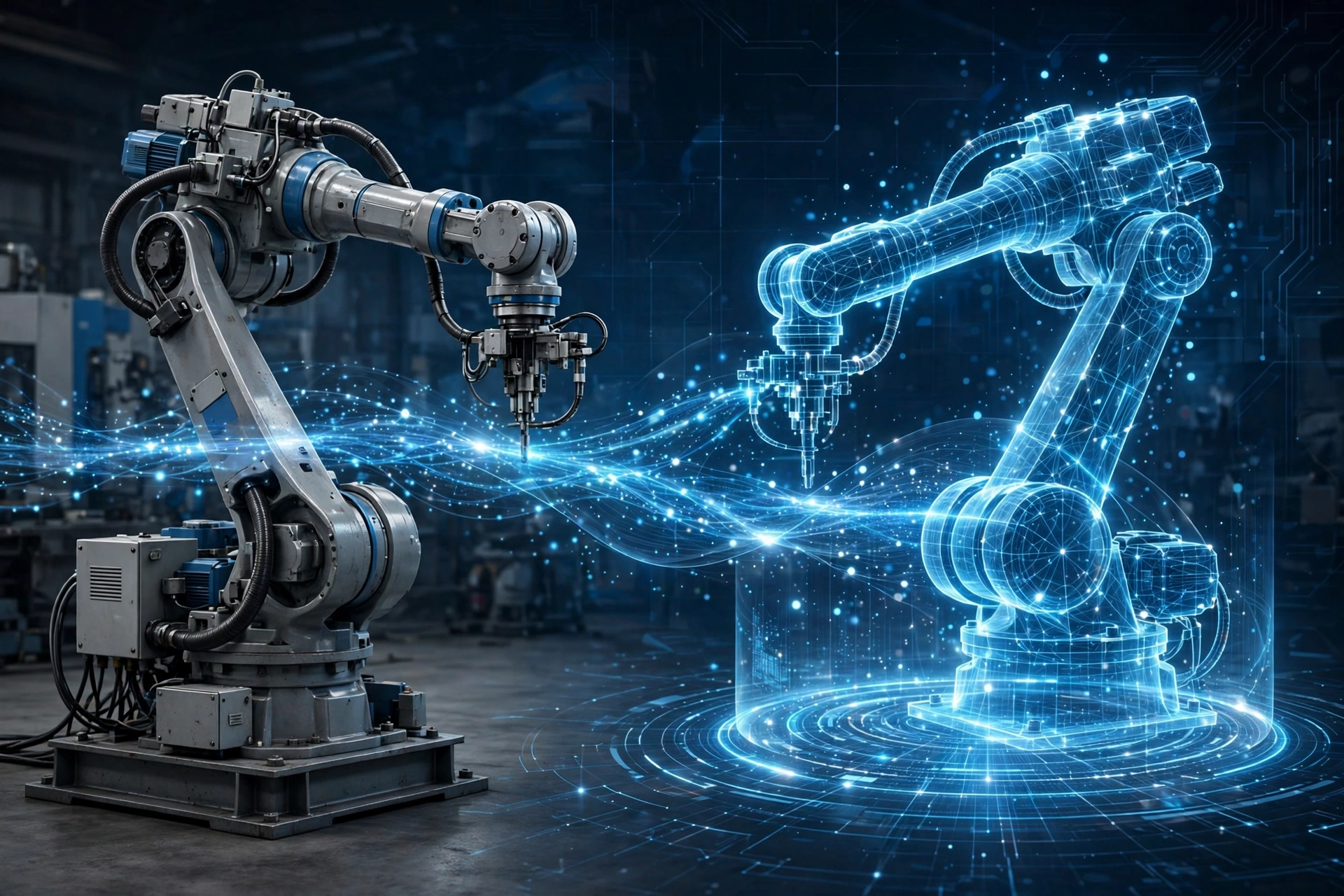
What if you could test a repair on a machine without ever touching the real one? That is not science fiction anymore. It is a digital twin at work, and it was one of the loudest topics at NVIDIA’s GTC Berlin this week.
On 19 October in Berlin, NVIDIA chief Jensen Huang said a company’s digital twin could one day become the workplace for most of its staff. Design would happen in the virtual copy. Robots would then build the real thing in the factory.
You do not need to run a factory to care about this. The same idea is now showing up in buildings, hospitals and city traffic systems. This guide explains digital twins in plain words, so you can spot the real uses and ignore the hype.
Digital Twins Explained in Simple Words
Digital twins explained simply: you build a virtual copy of a real thing, then you keep feeding that copy live data from the real thing. The copy stays in step. When the real machine heats up, slows down or wears out, the twin shows it too.
That live link is what makes a twin different. A photo of a machine does not change. A basic 3D model does not change either. The twin keeps changing, hour after hour, because sensors keep talking to it.
Think of a delivery van. Sensors track its engine heat, brake wear and fuel use. Its twin on a screen copies all of that in real time. A manager can then see a brake problem forming days before the van breaks down on the road.
How Is a Twin Different From a Simulation?
People mix these two up all the time. A simulation is a one-off test. You feed it some numbers, run it once, and study the result. Then you close it.
A twin is not a one-off. It stays connected to the real object for months or years. It collects fresh data every day. The twin also learns patterns from that data, so its warnings get sharper over time.
Here is a simple way to remember it. A simulation is like a rehearsal for a play. A digital twin is like a live mirror that also tries to predict what happens next. Our look at edge computing security shows why that live data flow needs protection close to the device itself.
What a twin needs to work
First, it needs sensors on the real thing. Second, it needs a fast, steady data link. Third, it needs software that can turn raw numbers into a clear picture a person can act on.
Miss one of those three, and you do not really have a twin. You just have a nice picture. That is a common mistake in early projects, and it is why some pilots quietly fail.
Where Digital Twins Already Do Real Work
Factories were the first home for this idea, and they still lead. A production line is expensive to stop. So engineers test a change on the twin first. If the twin says the change will cause a jam, they fix the plan before touching the real line.
Picture a small parts maker. One machine keeps failing on Friday afternoons. The data in its twin shows a heat spike every Thursday. The team changes the cooling schedule, and the Friday failures stop. No guesswork, just a pattern that was hidden before.
Buildings are next. A twin of an office block can track heating, lifts and energy use. Managers can test a new heating plan in the copy first. They can see the energy bill effect before they spend anything real.
Cities use the same trick on a bigger scale. A traffic twin can test what happens if a main road closes for repairs. Planners can reroute buses in the model first. That saves a week of chaos on real streets.
Healthcare is also testing twins, carefully. Researchers are building twins of organs and even of patients in trials, to predict how a treatment might work. This area is still early, and privacy questions here are serious. But the direction is clear in recent research funding in the US and Europe.
The IBM explainer on digital twins lists many of these same uses, from product design to predictive maintenance. The pattern is consistent: test safely in the copy, then act once in real life.
Why This Topic Is Trending Right Now
Three things pushed digital twins back into the headlines this October. First, physical AI got faster. Robots and machines now generate far more live data than they did a few years ago. More data makes a twin far more useful.
Second, computing power moved closer to the machine. That is the edge computing idea again. When data is processed nearby, the twin updates in seconds, not minutes. A slow twin is just history. A fast twin can warn you in time.
Third, big events put it on stage. GTC Berlin ran from 20 to 22 October, with digital twins and AI factories at the centre of the talks. When the head of NVIDIA spends a keynote on a topic, search interest follows fast.
This connects to the wider shift we covered in AI-powered ecosystems. Twins do not sit alone. They work best when sensors, AI models and cloud systems share data in one joined-up system.
The Honest Limits You Should Know
A twin is only as good as its data. Bad sensors give bad warnings. Missing data gives blind spots. If a team trusts a flawed twin too much, it can make a confident, wrong decision.
Cost is the second limit. Sensors, software and setup take money and skilled time. For a small business with one simple machine, a full twin may cost more than it saves. A simple maintenance log might be the smarter start there.
Privacy is the third limit, and it grows when people are involved. A twin of a building tracks how people move inside it. A twin of a patient holds very personal health data. Those uses need clear rules, consent and strong security from day one.
Security matters for the same reason. A twin holds a detailed map of how a real system works. In the wrong hands, that map helps an attacker plan. So twins need the same careful access controls as any other critical system.
What This Could Mean for Ordinary Services
You probably will not buy a digital twin for your home. But you will likely use services that rely on one behind the scenes. Your power company may use a twin of its grid to find faults faster. Your city may use one to plan road works with less disruption.
Car services are a good example. A garage that receives data from your car’s twin could call you before a part fails, not after. You book a calm repair on a Tuesday, instead of a breakdown on a motorway on Friday night.
Home heating could work the same way. A boiler twin could flag a failing pump while the house is still warm. That kind of early warning is the real promise here: fewer surprises, planned fixes, less waste.
If you want the bigger picture of where inventions like this are heading, our future tech inventions list puts twins alongside the other ideas shaping the next decade.
Frequently Asked Questions
What is a digital twin in one sentence?
It is a virtual copy of a real object or system that stays updated with live data, so you can monitor it, test changes and predict problems without touching the real thing.
Is a digital twin the same as a 3D model?
No. A 3D model shows how something looks. A digital twin also shows how it behaves right now, because it keeps receiving fresh data. The live link is the key difference.
Do digital twins use AI?
Often, yes. AI helps spot patterns in the stream of data and predict failures. But a twin can also work with simpler alerts and rules. AI makes it smarter, it is not the twin itself.
Are digital twins only for big factories?
No, factories started first, but buildings, traffic systems, energy grids and healthcare research now use them too. The scale changes, the basic idea stays the same.
What is the biggest risk with digital twins?
Trusting bad data is the top risk. If the sensors are wrong or incomplete, the twin’s advice will be wrong too. Privacy and security come close behind, especially when people are involved.
The Takeaway
Digital twins explained honestly are not magic. They are a live mirror with a useful habit: they let you rehearse a decision safely before you commit to it in real life. That is why factories, cities and hospitals keep investing in them, and why the topic lit up again at GTC Berlin this week. Watch the data quality and the privacy rules, and this is one future tech idea that earns its attention.