
Five Small Apps, Five Specific Jobs: An Overview
The contemporary digital fitness ecosystem is oversaturated with hyper-complex applications that mimic, for example, advanced biometric telemetry systems. For an individual initiating their fitness journey, encountering interfaces that mandate granular macronutrient logging, continuous heart rate zone calculations, and multi-tier periodization schedules creates immediate psychological friction. Instead of fostering behavioral adherence, feature overload routinely triggers early dropouts.
According to behavioral science principles, establishing sustainable habit loops requires minimizing the baseline barrier to entry. For novice trainees, cognitive simplicity must supersede algorithmic complexity.
This analytical review, therefore, evaluates five streamlined fitness applications engineered to optimize user compliance, lower cognitive load, and systematically build neuromuscular consistency without inducing administrative fatigue.
The Core Pitfall of Enterprise Fitness Platforms
Statistical analysis of mobile wellness applications indicates, for instance, that user churn spikes drastically within the initial seven days of deployment. This phenomenon is, consequently, primarily driven by administrative friction. When an individual is forced to execute multiple navigation inputs simply to record a low-intensity ambulatory session, the perceived operational cost outweighs the physiological benefit.
To cultivate long-term behavioral retention, application architecture must provide seamless execution pathways. Novice trainees require, above all, clean, distraction-free modalities that prioritize physical output over data inputs.
Nike Training Club (NTC): Optimization of Asynchronous Video Guidance
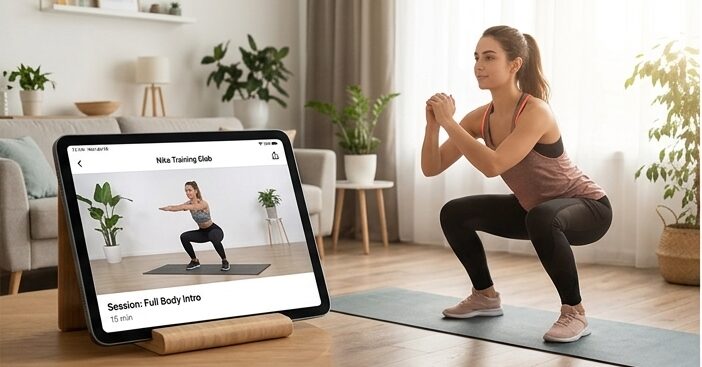
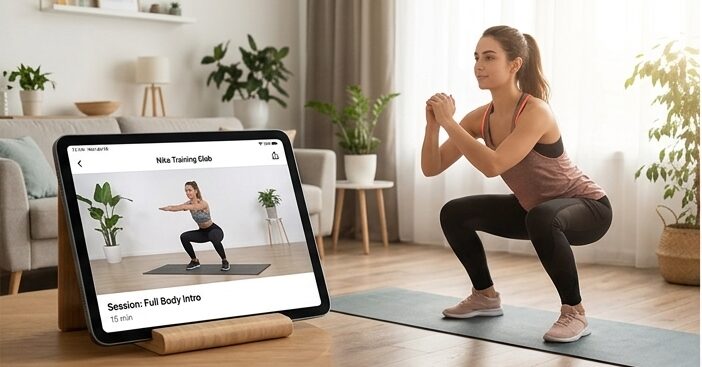
For individuals lacking foundational spatial awareness or familiarity with basic resistance training terminology (such as rotational sets, metabolic conditioning, or isometric holds), Nike Training Club serves, in fact, as an exceptional structural entry point.
Minimalist Interface Design
NTC utilizes a highly efficient filtering infrastructure. Users can instantly isolate training modules based purely on temporal availability and active equipment constraints. If a trainee possesses only a fifteen-minute window and zero external load assets, the system then dynamically populates targeted calisthenic routines.
Real-Time Biomechanical Modeling
Rather than relying on static timers or textual instructions, NTC embeds high-definition, real-time video demonstrations led by credentialed kinesiology professionals. This visual feedback loop ensures accurate form replication, mitigating the risk of acute kinetic strain.
Monetization Transparency
In a significant departure from standard monetization frameworks, NTC also provides unrestricted access to its foundational core library without enforcing premium paywalls or subscription gates at critical user milestones.
Couch to 5K (C25K): Incremental Cardiovascular Conditioning
Initiating a running regimen via continuous high-intensity exertion invariably leads to rapid physiological exhaustion or structural injuries such as medial tibial stress syndrome. Couch to 5K, however, solves this through precise, incremental load management.
Algorithmic Interval Training
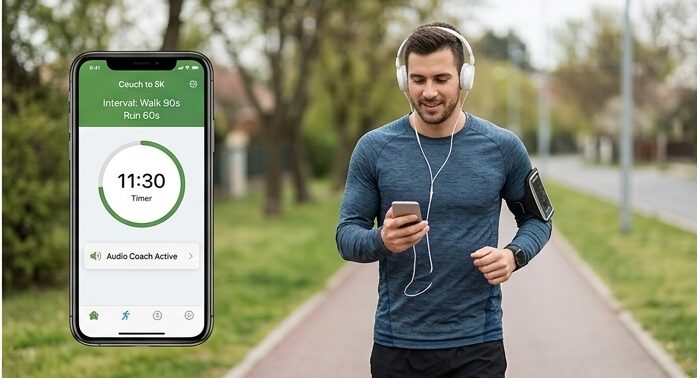
The software, in turn, executes a structured nine-week macrocycle engineered to transition users from a sedentary baseline to a sustainable five-kilometer cardiovascular capacity. Early phases also utilize low-impact interval ratios, alternating ninety seconds of active recovery walking with sixty seconds of low-velocity jogging.
Asynchronous Auditory Coaching
The application, as a result, removes the necessity for continuous visual monitoring during exertion. Integrated audio cues therefore deliver precise, real-time pacing instructions directly through the user’s audio device, preserving spatial awareness and technical execution during the running cycle.
Seven-Minute Workout: Temporal Efficiency and Gamified Compliance
For trainees operating under severe temporal constraints, the Seven application, in contrast, leverages high-intensity circuit training (HICT) protocols to maximize metabolic output within a condensed timeframe.
Scientific Circuit Architecture
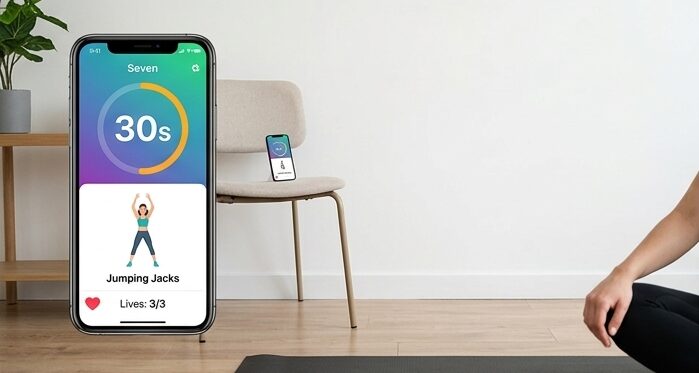
The application, for example, curates a sequence of twelve distinct bodyweight exercises executed for thirty seconds each, punctuated by mandatory ten-second recovery intervals. The entire protocol, therefore, requires only localized vertical support (a wall) and an elevated platform (a standard chair).
Retention Mechanics
Seven addresses behavioral compliance through gamification. Users are, in fact, allocated a finite balance of three operational “lives.” Omitting a scheduled daily training session, for instance, results in the automated forfeiture of a life asset; losing all assets triggers a total reset of the historical progress metric, introducing a powerful psychological mechanism for daily engagement.
JEFIT: Streamlined Progressive Overload Management
As a novice trainee transitions toward hypertrophy or basic strength acquisition, tracking external resistance metrics becomes imperative. JEFIT, in short, eliminates the complex data modeling typically associated with strength logging.
Pre-Configured Linear Progression Templates
While hosting a comprehensive kinetic encyclopedia, JEFIT’s utility for beginners resides, in particular, in its automated, pre-constructed routines, such as the fundamental 3-Day Full Body Novice Protocol.
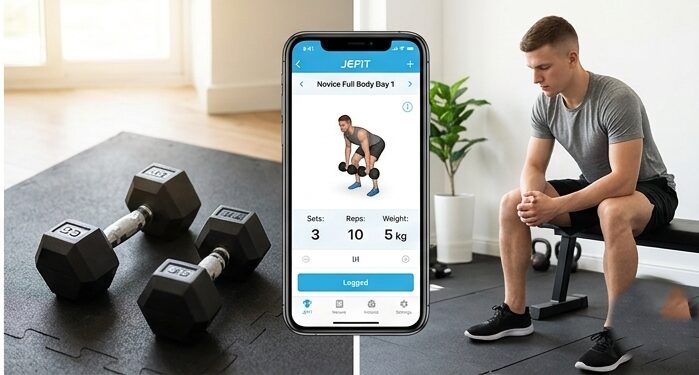
Postural Animations
Unfamiliar movements are, moreover, accompanied by looping, multi-angle biomechanical animations that display proper trajectory and joint alignment. Data logging is, in addition, restricted to simple quantitative inputs for mass and repetitions, bypassing complex maximum-capacity math calculations.
FitOn: Modality Diversification and Adaptive Low-Impact Variations
For users prone to workout monotony who require sensory variation—alternating between Vinyasa yoga, aerobic conditioning, and low-impact Pilates—FitOn, meanwhile, provides a highly versatile streaming infrastructure.
Biomechanical Modifications
A critical feature of the platform’s instructional design is the mandatory inclusion of active movement modifications. Instructors also visibly demonstrate low-impact alternatives on-screen simultaneously with the primary movement, allowing trainees with joint limitations or compromised flexibility to sustain engagement safely.
Comparative Operational Metrics
| Application | Primary Modality | Session Duration | Resource Requirements |
| Nike Training Club | Guided Bodyweight/Hypertrophy | 15-45 Minutes | Minimal / Variable |
| Couch to 5K (C25K) | Cardiovascular Endurance | 20 – 30 Minutes | Specialized Footwear |
| Seven | High-Intensity Bodyweight Circuits | 7 Minutes | Living Room Infrastructure |
| JEFIT | Structural Strength Tracking | 30 – 45 Minutes | Free Weights / Dumbbells |
| FitOn | Multi-Modality Group Fitness | 10 – 30 Minutes | Zero Equipment |
Strategic Selection Framework for Novice Trainees
To prevent cognitive paralysis and operational clutter, users should therefore avoid concurrent deployment of multiple tracking applications. Selection should be dictated by immediate behavioral goals:
- For outdoor cardiovascular adaptation, deploy C25K.
- For real-time biomechanical video modeling within a home environment, deploy Nike Training Club.
- For extreme temporal limitations requiring rapid metabolic activation, deploy Seven.
Long-term physiological adaptation depends, in summary, entirely on structural habit formation rather than software complexity. Select a single operational system, maintain deployment for a minimum three-day introductory macrocycle, and allow metabolic momentum to accumulate systematically.
Conclusion: The Primacy of Frictionless Interfaces
Ultimately, the efficacy of a digital fitness asset is determined not by feature density or pricing models but by its capacity to sustain user compliance. For the novice trainee, the primary objective is overcoming initial behavioral friction. By systematically eliminating unnecessary data monitoring, these streamlined platforms thus allow users to direct their limited energy toward physical execution, ensuring the development of sustainable fitness habits.
Frequently Asked Questions (FAQs)
What is the primary cause of beginner failure when using workout apps?
The most prevalent factors are, notably, a feature overload and administrative friction. When an application requires extensive manual inputs, data tracking, and navigation before a session, the cognitive barrier prevents consistent usage.
Can brief 7-minute applications yield measurable physiological benefits?
Yes. Clinical studies on high-intensity circuit training indicate that short bursts of bodyweight resistance improve metabolic conditioning, increase post-exercise oxygen consumption (EPOC), and successfully build the neurological pathways required for daily habit formation.
Is external resistance equipment mandatory for these applications?
No. The foundational architecture of platforms like Seven, FitOn, and Nike Training Club prioritizes bodyweight mechanics (calisthenics), allowing full operational utility without any financial investment in specialized gym hardware.
What is the recommended weekly training frequency for a novice?
Data suggests, specifically, an optimal baseline frequency of three to four active sessions per week. This distribution provides mandatory physiological recovery windows, minimizing the risk of overtraining syndrome and kinetic fatigue.
How do on-screen modifications protect beginners from injury?
Modifications, in brief, lower the mechanical load and joint stress of an exercise. By providing a simpler, alternative movement style on-screen, applications ensure that users with structural limitations can stay active without compromising safety.