
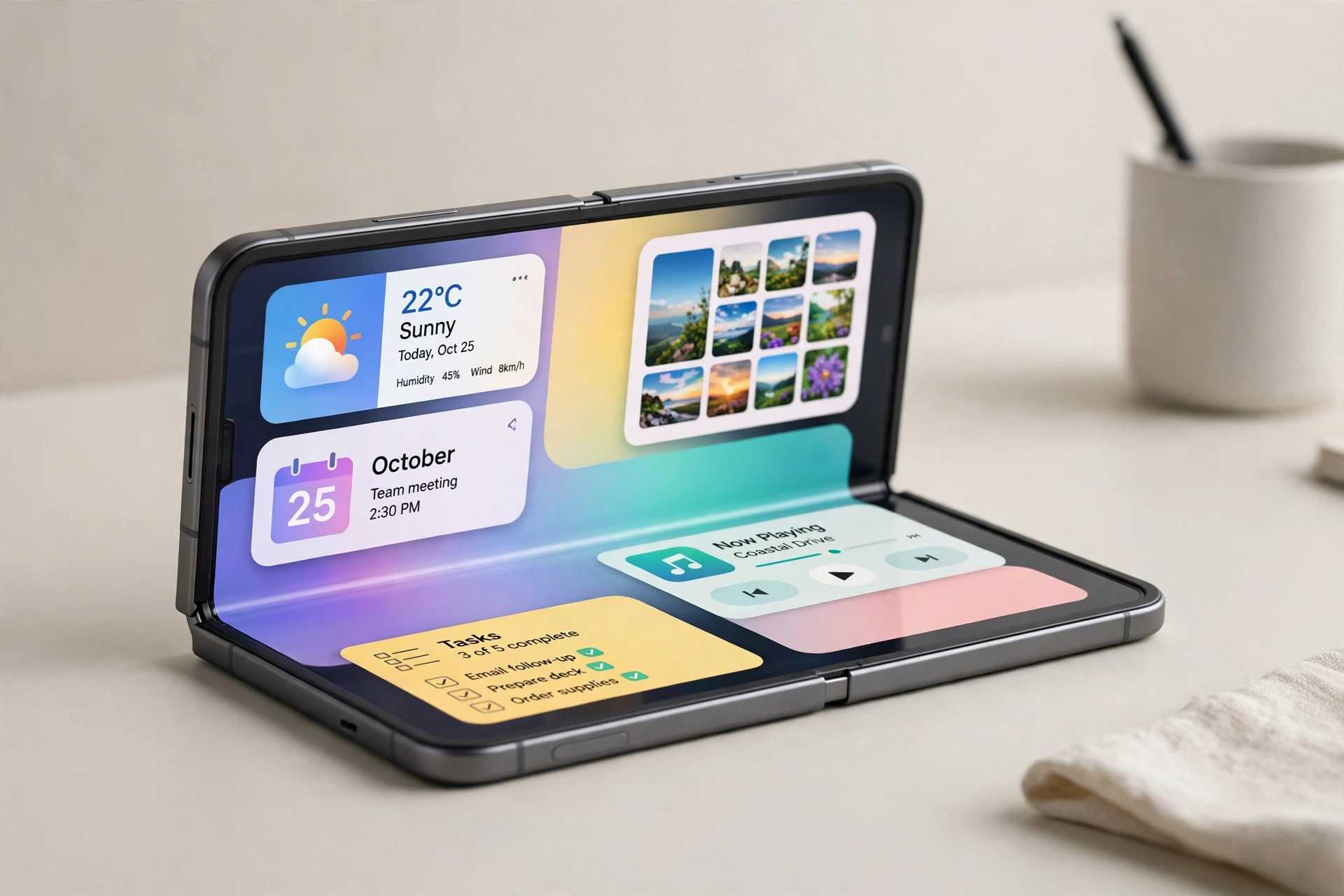
For years, Apple watched other phone makers fold their phones in half and said nothing. Samsung, Huawei, Motorola — they all shipped foldables while Apple stayed silent. That silence ended this week. Apple’s first foldable iPhone, the iPhone Duo, went on sale on Friday, October 23, and it is the most consequential iPhone launch in years. Not because everyone should buy one. Because it changes what an iPhone is allowed to be.
Here’s what happened, what the phone actually does, and — just as importantly — who should wait.
What Apple Actually Announced
Apple unveiled iPhone Duo in September 2026, calling it the first foldable iPhone. Pre-orders opened October 16, and the phone reached stores on October 23 in more than 70 countries and regions, with more markets following on October 30. On launch day, Apple’s own senior executives were on shop floors — John Ternus and Deirdre O’Brien in Austin, Greg Joswiak and Vanessa Trigub in New York — welcoming customers and demoing the hinge in person. When a company sends its top brass to a store opening, it’s telling you something: this phone needs to be held before it’s understood.
The headline numbers, all from Apple’s own announcement: opened up, the inner display measures 7.6 inches. Closed, the outer display is 5.4 inches — roughly the size of a passport, and about 90 percent of the screen area of an iPhone 18 Pro. The phone is built from grade 5 titanium polished to a mirror finish, comes in two colours (star white and night sky), and starts at $1,999 in the US. It runs on the A20 Pro chip and ships with iOS 27.
Two Screens, One Phone: Why the Fold Matters
Fold the phone shut and it’s a normal-ish iPhone you can use one-handed. Open it and you get a small tablet. That’s the whole pitch, and it’s a good one — if the software keeps up.
Apple’s answer is Split View, which lets you open two apps side by side on the inner display for the first time on an iPhone. Picture the real-life version: directions open on one side, a restaurant menu on the other. A video call on the left, your notes on the right. A spreadsheet that finally doesn’t feel like reading through a keyhole.
Both displays share the same aspect ratio, so content scales proportionally as you open and close the phone — no weird stretching, no apps suddenly reflowing into a different shape. And the inner display carries a special nano-texture finish that cuts glare, which matters more than it sounds when you’re using a big screen outdoors.
The hinge is the part Apple is proudest of, describing it as a precision hinge with a smooth, satisfying feel. That’s marketing language, sure — but the hinge is also the part that decides whether a foldable feels like a premium device or a party trick. It’s the thing to test in a store, repeatedly, before spending this kind of money.
The Price Question, Answered Honestly
Let’s not dance around it: $1,999 is a lot of money for a phone. The 256GB base model is the cheapest way in, with 512GB at $2,199, 1TB at $2,599 and 2TB at $3,199. Apple offers trade-in credit from $175 to $885 for an eligible iPhone 13 or newer, plus monthly financing and lease options, which softens the blow — but this is still a phone priced like a laptop.
So who is it actually for? Three groups, roughly. First, people who already carry both a phone and a small tablet and would happily merge them. Second, people who work from their phone — reading documents, juggling apps, taking video calls — and genuinely benefit from a bigger screen they can still pocket. Third, early adopters who want the newest thing and accept the first-generation trade-offs.
Who should skip it? If your current iPhone does everything you need, this phone doesn’t add a single feature you can’t live without — it adds screen space and multitasking, at double the price of a top regular iPhone. If you upgrade every four or five years, the smarter move is usually to wait for the second generation, when the hinge has a track record and the price has somewhere to go.
What Else Is New Inside
Beyond the fold, the Duo is a serious flagship. The A20 Pro chip is the same silicon powering the iPhone 18 Pro models, and Apple pairs it with a custom vapour-chamber cooling system and a dual-battery design — two batteries, one on each side of the fold — to keep performance steady and deliver all-day battery life.
The camera system gets a 48-megapixel Fusion main camera and an ultra-wide, and the folding design gives you a trick no slab phone can copy: prop the phone half-open like a tiny laptop and you have a hands-free camera stand built into the device. Group photos and video calls get easier without buying a tripod.
There’s also an under-display FaceTime camera on the inner screen, and iOS 27 is reimagined around the folding form — familiar to any iPhone user, but adapting as the device opens and closes. Apple Intelligence and the new Siri AI are in there too, though their usefulness will depend on where you live and which features have rolled out in your region.
What to Watch Before You Buy
First-generation hardware always carries questions no launch event can answer, and the Duo is no exception. Three things to watch in the coming weeks:
Real-world hinge durability. Apple says the phone is built to last, but a hinge is a moving part, and moving parts wear. Early reviews and long-term tests will tell us far more than a launch-day demo. If you’re spending $1,999, waiting a month for that evidence costs nothing.
App support. Split View is only as good as the apps that use it well. Apple’s own apps will be fine on day one. The question is how quickly everything else — your banking app, your work tools, your favourite games — adapts to a screen that changes shape.
Repair costs. A folding display is a more complex repair than a flat one. Before buying, it’s worth checking what AppleCare covers and what a screen replacement costs in your country. The sticker price is only part of owning a first-generation foldable.
None of this means the Duo is a bad phone. It means it’s a first-generation product at a premium price, and first-generation products reward patience.
Frequently Asked Questions
When did iPhone Duo go on sale?
October 23, 2026, in Apple Stores, on apple.com and in the Apple Store app, following pre-orders from October 16. More countries and regions follow on October 30.
How much does iPhone Duo cost?
It starts at $1,999 in the US for the 256GB model. Storage upgrades run to $2,199 (512GB), $2,599 (1TB) and $3,199 (2TB). Trade-in credit for an eligible iPhone 13 or newer ranges from $175 to $885.
Is iPhone Duo waterproof?
Apple gives the Duo an IP68 rating for dust and water resistance, the same class of protection as its flagship slab iPhones. That’s reassuring, but it’s not an invitation to swim with it — and folding mechanisms deserve a little more care than a sealed slab.
Should I upgrade from an iPhone 18 Pro?
Only if you specifically want the folding screen and the multitasking it enables. The chip and cameras are in the same class, so you’re paying for the form factor, not a leap in raw performance. If you’re happy with your current phone, waiting for the second generation is the sensible play.
The Bottom Line
iPhone Duo is a real milestone — Apple’s first foldable, and the first iPhone that genuinely changes shape to fit the moment. The hardware is ambitious, the software ideas are sound, and the launch-day crowds show there’s real appetite for it.
But milestones aren’t the same as must-buys. At $1,999, the Duo is for people who know exactly why they need a folding screen, and for everyone else it’s a fascinating preview of where iPhones are heading. The smartest move for most people is simple: go to a store, fold it yourself, and then decide with your hands, not with a headline.
Apple’s official announcement has the full specifications: Apple unveils iPhone Duo. For background on how foldables got here, see our earlier pieces on foldable device innovation, the best tablets of 2026 and the best smartphones.