
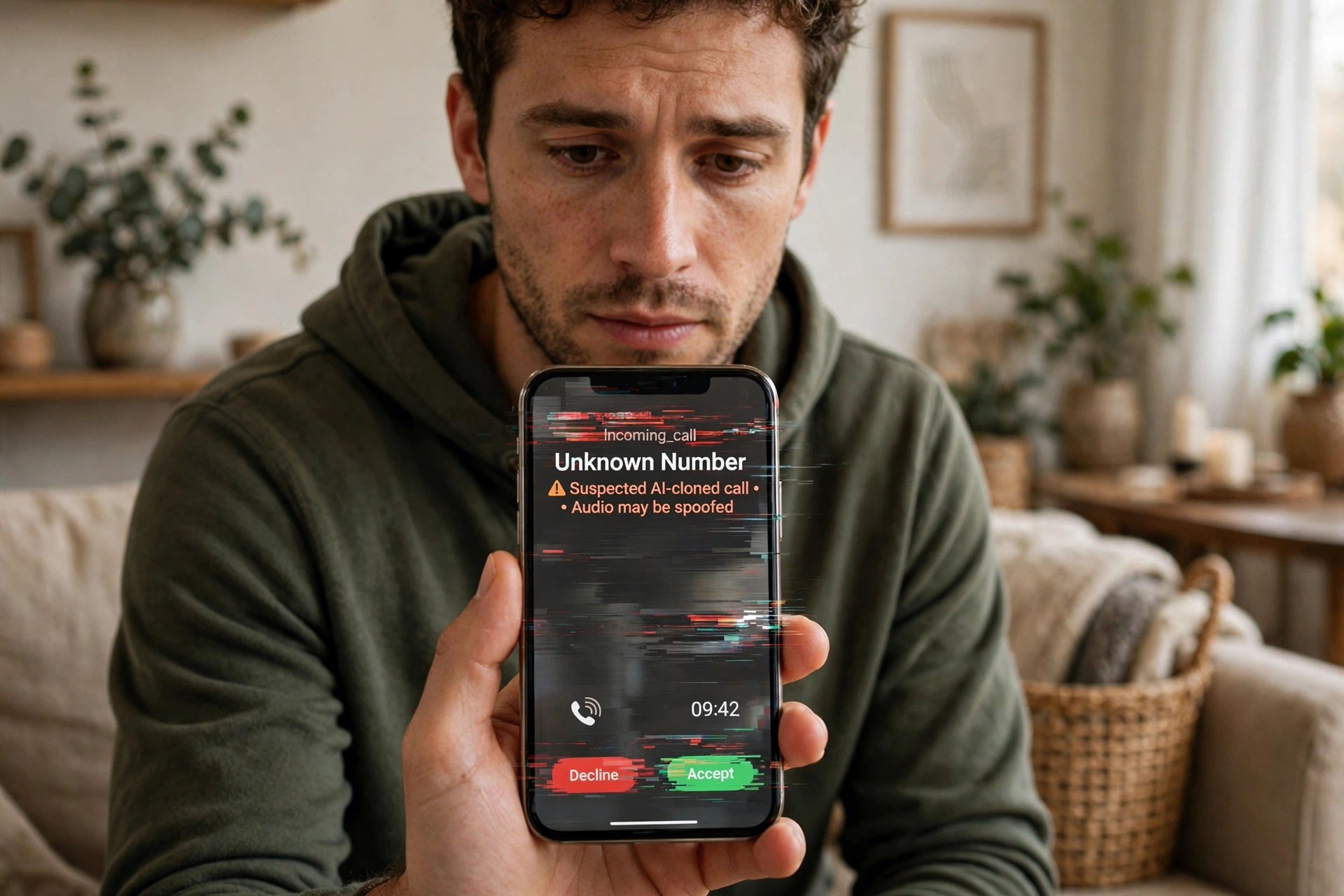
Last month, a retired schoolteacher got a call from her “grandson.” Same voice. Same laugh. She had no idea she was hearing AI social engineering in action.
He’d been in a car accident, he needed bail money fast, and please — don’t tell Mom. It wasn’t her grandson. It was a computer, speaking with a voice cloned from fifteen seconds of a birthday video she’d posted on Facebook. She sent the money before her daughter called back.
Stories like this are why the FBI now counts AI-related scams as their own category. And they’re why you need to understand AI social engineering — the oldest trick in the book, now running on the newest technology.
Social engineering, in plain words
First, forget hackers in hoodies breaking into computers. Social engineering is simpler and scarier: the scammer doesn’t break in at all. They talk their way in.
Sometimes they call pretending to be your bank. Other times it’s an email pretending to be your boss — or a text pretending to be your grandchild. Either way, the goal is always the same — to get you to hand over money, passwords, or access, willingly. The computer was never the target. You were.
For example, phishing emails are the most common delivery method for these tricks — our phishing prevention guide covers the email side in detail. But social engineering is bigger than email: it’s the manipulation underneath, whatever channel it arrives through.
Why 2026 changed everything: the AI twist
For years, scams had tells. Broken English. Blurry logos. A “bank email” from a random Gmail address. You could spot them if you looked closely.
Then AI erased the tells. In September 2026, the FBI’s Internet Crime Complaint Center issued a public warning: between January 2025 and July 2026, it received nearly 61,000 complaints about criminals impersonating police officers, judges, and federal agents — with reported losses topping $1.6 billion. The bureau tied the surge directly to generative AI: deepfake voices and video that sound and look exactly like real officials. McAfee’s breakdown of the FBI warning is worth a read if you want the full picture.
In fact, it gets bolder. In a separate July 2026 warning, the FBI said scammers are now impersonating the FBI’s own complaint center — using AI-generated videos of senior officials to promote fake complaint websites that steal your details. And for the first time ever, the bureau counted AI-related internet crime as its own category: roughly 22,000 complaints, nearly $893 million in losses in a single year.
Worse still, even your family isn’t off-limits. Fraudsters pull short voice clips from social media — a birthday video, a voicemail greeting — and clone them well enough to fool a grandmother. In particular, the “grandparent scam” has been around for decades; AI just gave it a perfect disguise.
The five AI social engineering tricks they keep reusing
Still, strip away the technology and every AI social engineering scam runs on one of five old plays. Learn them and you’ll recognize the scam no matter what it looks like:
1. Urgency — “act in the next ten minutes.” Your account will be frozen. The offer expires tonight. The arrest warrant is being processed. Urgency exists for one reason: to stop you thinking. Real banks and real officials never need your money right now.
2. Authority — “this is the police / your bank / tech support.” A badge number, a case file number, an official-sounding department. It all sounds real because it’s designed to. But think about it: when has your actual bank ever called demanding gift cards?
3. Someone you trust — “it’s me, Grandma.” The grandchild in trouble. The boss asking you to buy gift cards for clients. A colleague sharing an “urgent document.” Thanks to AI voice cloning, this has become the fastest-growing trick of 2026 — the voice is real, the person isn’t.
4. The too-good offer — “you’ve won / double your crypto.” Prizes you never entered. Investments that can’t lose. A romance with someone impossibly perfect who suddenly needs money for a plane ticket. If it triggers greed or excitement instead of suspicion, that’s the point.
5. The helpful stranger — “we can get your money back.” This one’s cruel: after you’ve been scammed once, someone calls offering to recover your losses — for a fee. The FBI specifically warns that its complaint center never asks for payment to recover funds. Anyone who does is running the second half of the con.
Why smart people fall for AI social engineering
Now here’s the part nobody likes to admit: falling for a scam isn’t about intelligence. AI social engineering is engineered to bypass thinking entirely — it aims at speed and emotion, not logic.
After all, the scammer’s whole script is built around one insight: a calm person verifies, a panicked person complies. So they manufacture panic. Fear of arrest. Fear for a grandchild. Excitement about a prize. Every strong emotion narrows your thinking down to exactly one option — theirs.
The numbers back this up: FBI complaint data shows who’s paying the highest price: people over 60 account for the majority of reported losses in government-impersonation scams. This isn’t because they’re less sharp — instead, scammers deliberately aim the authority and family tricks at them, and because shame keeps many victims quiet until it’s too late. If this article does one thing, let it be this: talk about scams with your parents. Out loud. Before the call comes.
The one habit that stops AI social engineering
As a result, you cannot out-detect AI anymore. A cloned voice won’t glitch. A deepfake video won’t flicker. So stop trying to spot the fake — and build one habit instead: pause, and verify through a channel you trust.
For instance, the FBI calls its version of this habit “Take a Beat.” Whenever an unexpected message asks for money, codes, or personal details:
- Check — look closely at who is actually contacting you, not who they claim to be.
- Call — hang up, then contact the person or company yourself using a number you already know (the one on your bank card, never the one in the message).
- Wait — give it an hour. Every scam depends on you acting now; none of them survive you sleeping on it.
As a result, that’s all it takes: no software to buy, no tell to memorize. The pause breaks the urgency, and the independent callback breaks the impersonation. Together they defeat every AI social engineering trick on the list above.
Set a family code word this weekend
So here’s a practical move that costs nothing: agree on a secret word or phrase with your family — something no scammer could guess from your social media. “Blue umbrella.” “Mango pickle.” Anything.
In practice, the rule is simple: any family emergency call that doesn’t include the code word gets verified first — no exceptions, no guilt. Tell your parents this explicitly, because the hardest part of the grandparent scam isn’t the technology. It’s a grandparent’s fear of seeming unhelpful. Give them permission, in advance, to hang up on their own “grandchild.”
If you already responded: the first hour
Still, it happens. Shame is the scammer’s best friend after the fact — don’t let it win. Here’s what to do, in order:
- First, call your bank immediately using the number on your card — never any number the caller gave you. Fast reporting is how fraudulent transfers get reversed.
- Next, if you shared passwords, change them now, starting with your email — and switch on two-factor authentication everywhere it matters. Our top cybersecurity practices guide walks through the essentials.
- Then report it to the FTC’s fraud reporting site and to local police. Reports feel pointless; they’re how patterns get caught.
- Finally, tell someone you trust what happened. You’ll feel better — and you’ll inoculate them against the same trick.
Keep in mind that these campaigns keep mutating: our look at the persistent threat of phishing explains why the same tricks keep resurfacing in new disguises every year.
FAQ
What’s the difference between phishing and social engineering?
Social engineering is the manipulation itself — tricking a person instead of hacking a system. Phishing is one delivery method for it (fake emails, texts, calls). All phishing is social engineering, but not all social engineering is phishing.
Can AI really clone someone’s voice from a short clip?
Yes. For example, scam operations now build convincing voice clones from seconds of audio pulled from social media videos, voicemails, or posts. That’s why the “grandchild in trouble” call sounds exactly right — the voice is real, the emergency isn’t.
What should I do if my “bank” calls me?
Hang up politely and call the bank yourself on the number printed on your card or in its official app. Never verify your identity to someone who called you — make them prove it through a channel you started.
Is it rude to just hang up on a suspected scammer?
Not at all. A real official will understand, and a scammer is counting on your politeness to keep you on the line. Hanging up is a security decision, not a social one.
Does this really happen to ordinary people?
Unfortunately, constantly. The FBI logged around 22,000 AI-related complaints in a single year with nearly $893 million in reported losses — and those are only the cases people reported. It happens to teachers, engineers, and executives alike.
The bottom line
In the end, social engineering works because it targets the one part of your setup no software can patch: human trust. In other words, AI didn’t invent the con — it just gave the con artist a perfect mask.
So you don’t need to become a human lie detector. You need one habit: pause, verify through a channel you trust, and never let urgency make your decisions. Teach it to your parents this weekend. That single conversation might be worth more than any security software you’ll ever buy.